
In 2026, getting traffic to your website is no longer the biggest challenge. The real challenge is converting that traffic into paying customers.
Most websites lose a large percentage of visitors because:
- They don’t engage instantly
- They don’t guide users properly
- They rely on static forms instead of dynamic interaction
This is where AI chatbots completely change the game.
A well-designed AI chatbot doesn’t just answer questions — it actively guides visitors, qualifies them, and moves them toward a purchase decision.
Let’s break down how you can use AI chatbots to turn your website into a high-converting sales system.
1. Engage Visitors Instantly (First 5 Seconds Matter)
When a user lands on your website, you have only a few seconds to capture their attention.
If nothing happens, they leave.
AI chatbots solve this by initiating a conversation immediately.
Instead of waiting for the user to take action, the chatbot:
- Greets the visitor
- Asks a relevant question
- Offers help
For example:
“Looking for a solution to grow your business or automate support?”
This simple interaction makes your website feel active and responsive.
2. Replace Static Forms with Conversational Lead Capture
Traditional forms are one of the biggest conversion killers.
They feel boring and require effort.
AI chatbots replace forms with conversations.
Instead of asking users to fill out multiple fields at once, chatbots:
- Ask one question at a time
- Guide users step by step
- Collect information naturally
This significantly increases the chances of users completing the process.
More completions = more leads.
3. Qualify Leads in Real Time
Not every visitor is ready to buy.
AI chatbots help you identify who is serious and who is not.
They can ask qualifying questions such as:
- What service are you looking for?
- What is your budget range?
- When do you want to get started?
Based on responses, the chatbot can:
- Route high-quality leads to your sales team
- Nurture low-intent users
- Provide relevant information
This ensures your focus stays on leads that matter.
4. Guide Users Through a Clear Sales Path
Many websites fail because they don’t guide users.
Visitors get confused and leave.
AI chatbots act as a guide.
They help users:
- Understand your services
- Compare options
- Make decisions
Instead of exploring randomly, users follow a structured journey.
This increases clarity and reduces drop-offs.
5. Provide Instant Answers to Remove Objections
One of the biggest reasons users don’t convert is unanswered questions.
AI chatbots eliminate this problem by providing instant responses.
They can handle:
- Pricing-related questions
- Service details
- Process explanations
- Common concerns
By removing doubts instantly, chatbots reduce friction and increase trust.
6. Use Smart CTAs Inside Conversations
A chatbot is not just for conversation — it is also a conversion tool.
You can include strong calls-to-action (CTAs) within the chat flow, such as:
- Book a consultation
- Get a quote
- Contact the team
- Start now
Because these CTAs appear at the right moment in the conversation, they perform better than traditional buttons.
7. Shift Conversations to WhatsApp for Higher Conversions
Website interactions are temporary.
Once the user leaves, the connection is lost.
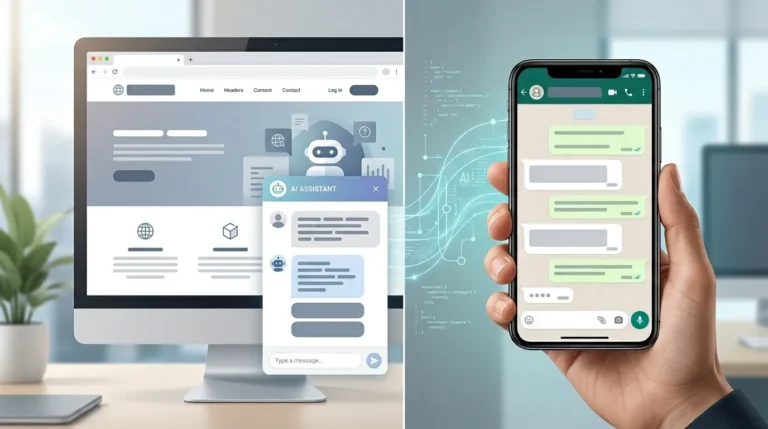
AI chatbots can move conversations to WhatsApp, where engagement is higher.
For example:
- After capturing a lead, the chatbot asks to continue on WhatsApp
- Follow-ups happen automatically
- Conversations feel more personal
This transition increases the chances of conversion significantly.
8. Personalize User Experience
Generic experiences don’t convert well.
AI chatbots can personalize interactions based on:
- User behavior
- Previous responses
- Preferences
They can recommend specific services or solutions based on what the user is looking for.
This makes the experience more relevant and increases the likelihood of conversion.
9. Capture and Store Data for Follow-Ups
Even if a user does not convert immediately, their data is valuable.
AI chatbots can:
- Capture contact details
- Store user preferences
- Track interaction history
This allows you to follow up later with:
- Emails
- WhatsApp messages
- Offers
Many conversions happen after follow-ups, not during the first visit.
10. Analyze and Optimize Performance
AI chatbots provide valuable insights into user behavior.
You can track:
- Drop-off points
- Frequently asked questions
- Conversion rates
This data helps you:
- Improve your chatbot flow
- Optimize your website
- Increase conversions over time
Continuous improvement is key to long-term success.
Common Mistakes to Avoid
Even with AI chatbots, poor implementation can reduce effectiveness.
Avoid these mistakes:
- Asking too many questions at once
- Using generic responses
- Not guiding users clearly
- Ignoring follow-ups
A chatbot should feel helpful, not overwhelming.
Real Conversion Strategy Example
A simple high-converting chatbot flow looks like this:
- Welcome the visitor
- Ask what they are looking for
- Qualify their needs
- Provide a relevant solution
- Capture contact details
- Offer a clear next step
This structured approach ensures that every visitor is guided toward conversion.
Final Thoughts
AI chatbots are one of the most powerful tools for increasing website conversions in 2026.
They transform your website from a passive platform into an active sales system.
With the right strategy, chatbots can:
- Engage visitors instantly
- Qualify leads automatically
- Guide users through decisions
- Convert more customers
If your website is getting traffic but not generating enough sales, implementing a custom AI chatbot could be the missing piece.